Music and Memory

On my old iPod, I had playlists organized by the location where I had lived to that point in my life: Wisconsin, Chicago and Virginia Tech.

A catchy chorus with a slick chorus can pull an image to the forefront of your memory bank and evoke a rush  of emotion — sadness, adrenaline.

Forever in my mind, House of Pain’s Jump Around will only mean the break between the third and fourth quarters at Camp Randall Stadium. And I’m not going to lie, I get a little annoyed when played in other venues like it’s almost sacriligous. As irrational as it may be, I feel in my heart that Wisconsin has earned exclusive access to the anthem.

Regulators will always be the theme of my senior class’s Homecoming theme.

Not really much else to say, but what songs are stuck in your head and associated with certain events in your life?

Just For Fun Week 15 NFL Picks

Just For Fun Week 15 Picks
Periscope

Went 8-7 last week.
Los Angeles at Seattle
Green Bay
at Chicago
Jacksonville at Houston
Cleveland at Buffalo
Philadelphia at Baltimore
Tennessee at Kansas City
Detroit at New York Giants
Indianapolis at Minnesota
Pittsburgh at Cincinnati
New Orleans at Arizona
San Francisco at Atlanta
New England
at Denver
Oakland at San Diego
Tampa Bay at Dallas
Carolina at Washington

The most wonderful time of the year

It’s the most wonderful time of the year. That’s right, folks … college football bowl season.

To make it a little more interesting (for myself at least), here are my just for fun picks for today’s games so you can make fun of me later. Ridicule all of picks at http://games.espn.com/college-bowl-mania/2016/en/entry?entryID=506923.

Without further ado, here are today’s picks …

New Mexico vs. Texas-San Antonio
UCF Knights
vs. Arkansas State
Houston vs. San Diego State
Southern Mississippi vs. Louisiana-Lafayette
Appalachian State vs. Toledo Rockets
North Carolina Central vs. Grambling State


Just For Fun Week 14 NFL Picks [Excluding TNF]

nflshieldlogoJust for fun Week 14 NFL picks …

12 p.m. CT Games
Pittsburgh at Buffalo: Pittsburgh
Denver at Tennessee: Denver
Washington at Philadelphia: Washington
Arizona at Miami: Arizona
San Diego at Carolina: San Diego
Cincinnati at Cleveland: Cincinnati
Chicago at Detroit: Detroit
Houston at Indianapolis: Indianapolis
Minnesota at Jacksonville: Jacksonville

3:05 p.m. CT
New York Jets at San Francisco: New York Jets

3:25 p.m. CT
New Orleans at Tampa Bay: Tampa Bay
Atlanta at Los Angeles: Atlanta
Seattle at Green Bay: Seattle
Dallas at New York Giants: Dallas

Monday Night Football (7:30 p.m. CT)
Baltimore at New England: New England


The ‘Three E’s’ of the Consumer Financial Protection Bureau

s)-‘Three E’s’ can be counted on to prepare citizens with the information to make sound financial decisions. This is the strategy that the Consumer Financial Protection Bureau (CFPB) has employed since its creation after the Great Recession of 2008 to empower, enforce and educate consumers.

CFPBFeb10v2

University of Utah S.J. Quinney School of Law professor Christopher L. Peterson was charged with evaluating the performance of the CFPB since its origin. His findings were based around seven key points that were published in a report titled, Consumer Financial Protection Bureau Law Enforcement: An Empirical Review.

“Many people believe that the deck is stacked against middle-class families,” said Peterson. “And there is real reason for concern. But the news out of Washington is not all bad. More than any time in a generation, financial institutions have to think twice before they swindle their customers.”

Empowerment is given to CFPB constituents with tools, answers to frequently asked questions, and tips to make financial choices and look for the best deal.

Enforcement ensures that parties found guilty of violations return funds to affected consumers.

Education is provided in the form of research for financial success in every stage of life.

“The Consumer Financial Protection Bureau’s law enforcement cases put over $11 billion back in consumers’ pockets when they were cheated by financial institutions,” said Peterson. “The research shows that in the ten years since the financial crisis, the federal government has created a more proactive, modern financial regulator that is working on behalf of the public interest.”

Peterson’s seven major points were …

  1. The CFPB has not lost a case since its start through 2015. One hundred twenty-two actions have generated over $11 billion in consumer remedy and forgiven debts.
  2. When the financial companies illegally deceived consumers, the CFPB recovered over 90 percent of all damages sought.
  3. For instances when collaboration with other agencies was needed, over 90 percent of all consumer relief was awarded to the CFPB.
  4. Not a single CFPB enforcement action has been contested.
  5. Individual senior managers at financial companies have been held responsible for illegal acts.
  6. The Consumer Financial Protection Act’s new “abusive” acts and practices standard have been carefully enforced.
  7. About $9.3 million were brought about per employee for public cases involving illegal financial practices concluded last year.

The ‘three E’s’ of the CPFB’s mission will continue to help consumers understand their options and comparison shop all while helping companies limit the impact of the seven issues raised in Peterson’s findings.

Eight Pillars of Leadership: Daniels Fund Ethics Initiative Accepting Nominees

This is not intended to be an original piece and is meant to build a writing sample portfolio. This is a rewrite of original University of Utah press release found at eccles.utah.edu. Daniels’ biographical information was found at danielsfund.org.

Bill Daniels raised $300,000 for education, opened his home to nonprofit organizations for fundraising events and donated that same home to the City of Denver for use as its permanent mayoral residence.

Ethics_initiative

No one wielded the power of ethics and philanthropy in business better than Daniels, who built his honest yet fair business acumen on eight standards that should be upheld by the leaders of Utah’s private companies, nonprofit organizations and government agencies in today’s business climate and well into the future.

The Daniels Fund Ethics Initiative in the University of Utah’s David Eccles Schools Business and the Community Foundation of Utah are requesting nominees for the 2016 Utah Ethical Leadership Awards. Recipients will be honored as the very best of the Beehive State’s most ethical business officials during a breakfast ceremony on Sept. 9. Three finalists from each of the three categories will be featured in Utah Business Magazine.

“It’s important for our community to pay tribute to companies and organizations that exemplify ethical behavior and integrity in their operation,” said Dr. Abe Bakhsheshy, director and professor of the Eccles School Daniels Fund Ethics Initiative. “We’re honored to recognize the individuals who espouse ethical principles in their organizations at the annual Utah Ethical Leadership Awards.”

To apply for the award, please fill out the nomination form at utahcf.org by July 15.

Nominees will be evaluated according to Daniels’ eight standards and how they compare to the Daniels Fund Ethics Initiative’s absolute ethical principles, criteria, quantitative measurements and qualitative measurements for …

  1. Integrity: Act with honesty in all situations.
  2. Trust: Build belief in all stakeholder relationships.
  3. Accountability: Accept responsibility for all decisions.
  4. Transparency: Maintain open and factual communications.
  5. Fairness: Engage in fair competition and create equitable and just relationships.
  6. Respect: Honor the rights, freedoms, views and property of others.
  7. Rule of Law: Comply with the spirit and intent of laws and regulations.
  8. Viability: Create long-term value for all relevant stakeholders.

“The Utah Ethical Leadership Awards recognize Utah businesses, nonprofit organizations, and government entities that embody best practices in ethical behaviors,” said Utah Governor Gary Herbert. “The finalists and awardees are a great representation of Utah’s principle-based ethical leadership.”

Daniels’ long-lasting innovations, like the Young Americans Bank that is still in operation today after being started in 1987 or ethics, values and personal integrity being woven into the University of Denver’s Daniels College of Business curriculum, still influence today’s business world.

With any luck, the recipients of the 2016 Utah Ethical Leadership Awards will share a similar influence in the future.

INFORMED DECISIONS 2016 Snapshots: U. of Utah Conducts Focus Groups

This is not intended to be an original piece and is meant to build a writing sample portfolio. This is a rewrite of original University of Utah press release found at gardner.utah.edu

ID16logoFInal-e1458066469693

Salt Lake City (Aug. 1, 2016) – More educational opportunities that lead to earning a degree or certificates. Increased assistance for teachers through state funding. Building consistent Utah Transit Authority performance and service levels. Reevaluating the state’s stance on gas tax and taxing e-commerce transactions.

Education, infrastructure and taxes issues were revealed to be the most important issues to Utah voters by the University of Utah’s Kem C. Gardner Policy Institute and the Hinckley Institute of Politics during its focus groups last April and May for the INFORMED DECISIONS 2016 campaign.

“The issues presented in these Snapshots, along with upcoming events and issue briefs, will help voters and candidates alike prepare for the voting booth,” said Jason Perry, Hinckley Institute of Politics Director.

In a collaboration with KSL Broadcasting and the Deseret News, six focus groups made up of citizens from the public, business, nonprofit organization and government backgrounds to build an image of what Utahns will value as the general elections approach in November.

“We put a lot of stock in the heartfelt comments made by these community members and leaders, and we’re grateful for their insights,” said Kem C. Gardner Policy Institute Director Natalie Gochnour.

Education

  • Increased priority given to early childhood education.
  • Educators need to be valued at a higher level.
  • Access to postsecondary education is essential for all Utah families.
  • More stability and funding from state legislature was requested.
  • For details about this focus group conducted in concert with the Utah Education Policy Center, please visit gardner.utah.edu.

Infrastructure

  • Legislature should continue to try increase the gasoline tax.
  • Frustration about performance of Utah Transit Authority, especially in western Salt Lake County.
  • The issue of subsidizing, instead of monetizing, use of water and lack of incentive to conserve.
  • Long-term strategic planning for transportation, air quality along with land and water use.
  • For details visit gardner.utah.edu.

Taxes

  • Efficiency, fairness, simplicity and transparency is needed.
  • Taxing online purchases has its share of support.
  • The state has managed the Great Recession in an effective manner.
  • Tax breaks for out-of-state corporations were not supported.
  • For details visit gardner.utah.edu.

The next component of the INFORMED DECISIONS 2016 platform is a series of Candidate Conversations beginning Monday, June 20 at 10:30 a.m. in the Moot Court at the University of Utah. Republican Third District Congressman Jason Chaffetz and his Democratic challenger Chia-Chi Teng will be in attendance.

“We hope the findings will spur everyone to learn more about the issues and cast votes during this year’s important primary and general elections,” Gochnour said.

The event will be broadcast on KSL-TV and live streamed on hinckley.utah.edu. More information is available at gardner.utah.edu and hinckley.utah.edu.

“While national politics is predictably taking center stage, Utah voters have a chance to make a real difference at the state and local levels,” said Perry.

By: Mike DeVine

The Wisconsin School of Business Celebrates The Consortium’s 50th Anniversary

This is not an official University of Wisconsin-Madison School of Business publication and is only intended to serve as a display of my writing ability.

After becoming a charter member of The Consortium for Graduate Study in Management in 1966, the Wisconsin School of Business has helped nearly 700 students earn appointments in business schools and corporations as part of an effort to increase the representation of African Americans, Hispanic Americans and Native Americans in American business.

download

As The Consortium celebrates its 50th anniversary, leaders from the Wisconsin School of Business reflected on the role that the University of Wisconsin-Madison has played in the program that has equipped under represented groups with the skill set to attain careers in business.

“[The Consortium] has really leveraged the intersection between the private sector and academic institutions to really bring together, to cover societal gaps, so increased access to education for students to diversify the workforce and to really leverage that both in academia and in the corporate sector has been very powerful,” said Director of Diversity and Inclusion for the Wisconsin School of Business Binnu Palta Hill.

Washington University’s Professor Sterling Schoen led a group of 60 respected educators, business managers and community leaders that teamed who teamed with the University of Wisconsin-Madison, Washington University and Indiana University-Bloomington.

“The fact that [The Consortium] is 50 says a lot about the sustaining power of what the idea was 50 years ago,” said the Albert O. Nicholas Dean of the Wisconsin School of Business François Ortalo-Magné. “It would have been interesting to ask those who did the founding 50 years ago what does this look like 50 years from now. It says a lot about how important that idea was and see how it has grown.”

Keeping in stride with the Wisconsin Idea that university resources should be used to improve the lives of all citizens, the Wisconsin School of Business has had a part in structuring The Consortium since its inception and has been a key cog in the discussion regarding interaction around employers, business school and inclusion issues at UW-Madison.

“A key piece of the legacy of the 50th is the fact that Wisconsin was progressive enough 50 years ago to say yes to the idea,” said Assistant Dean of the Wisconsin Full-Time MBA Program and a member of The Consortium Board of Directors. “I mean it really is very Wisconsin-est to be out front and to join into an idea that almost was before its time and going back to that root word of consortium, the Latin word consortium really means partnership and Wisconsin joined two other great universities to be a part of this 50 years ago and that’s quite amazing.”

As excited as Ortalo-Magné, Sanford and Palta Hill were to celebrate this milestone, they looked forward to the next 50 years of progress.

“I hope then the 100-year anniversary is the celebration of irrelevance,” said Ortalo-Magné.

Experience Utah’s Past World

This is not an official Natural History Museum of Utah publication and is only intended to serve as a display of my writing ability.

Have you ever wanted to walk among the prehistoric denizens of Utah? What does a hadrosaur look like? How long is barosaur’s neck? And what is a proto-tryanosaur? Well, the Natural History Museum has you covered!

The Past Worlds exhibits is just one of 10 permanent exhibits that displays research-laden artifacts.

Past_Worlds_Concept

Image courtesy of Natural History Museum of Utah.

Your journey at the George S. and Dolores Doré Eccles Gallery (Map) through Past Worlds begins with the earliest known prehistoric habitants, and leads you to the Lake Gallery and the modern-day ecosystem you’d find when you visit the Great Salt Lake. That journey include an awe-inspiring view of a world-class hadrosaur mount, one that rivals the likes of internationally-renowned Sue the T-Rex. Devote some extra time to the hadrosaur because it stands out in relation to its cast counterparts. NHMU paleontologists unearthed nearly 80 of this animal and used its original fossil material to demonstrate, not only its grandeur, but the weight and texture of the minerals that used to be its skeleton.

g1870_gryposaurus_2

Image courtesy of Natural History Museum of Utah.

Learn about the diversity of Utah’s prehistoric inhabitants through the different eras while scrutinizing wonderful graphic murals that illustrate the environment during that time.

Cast your vote in the Cleveland-Lloyd Dinosaur Quarry mystery as you investigate an exhibit on ‘Allosaur,’ the state’s official fossil.

allosaurusg1610_ORIG_adj copy_6

Image courtesy of Natural History Museum of Utah.

Continue to an intriguing exhibit on biodiversity, the wall of ceratopsian skulls. This isn’t your grandma’s Triceratops. The ceratopsian family was as diverse as the day is long. And, if you don’t believe that, take it up with devil himself, Diablo Ceratops (Oh, you’ll see him on the wall!).

ceratopsian-skulls-nhmu

Image courtesy of allosaurusroar.com.

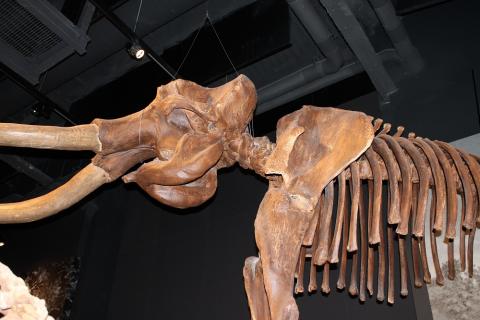
Enter the pleistocene era where creatures begin to resemble what we know today, including the Wooly Mammoth, who stomped along the shores of ancient Lake Bonneville.

Mammuth_0

Image courtesy of Natural History Museum of Utah.

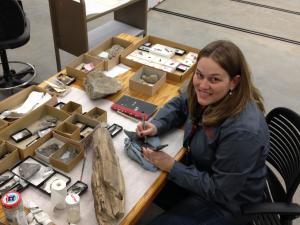
Grab your field kit and become a paleontologist for a day in the ‘dinosaur gig’ by observing how staff members get specimens ready for research and display in the S.J. and Jessie E. Quinney Foundation Paleontology Preparation Lab.

Carrie in Collections

Image courtesy of Natural History Museum of Utah.

You can then mill through the mineral reference collection and view the Triassic plant display in the Ruth Eleanor Bamberger and John Ernest Bamberger Memorial Foundation Learning Lab.

images.jpg

Image courtesy of Natural History Museum of Utah.

Then be sure to finish off your day of hard work as a guest an Ice Age dinner party.

Learn more at nhmu.utah.edu.